 Bojan
BojanFrom Zapier to AI Agents: The Four Levels of Business Automation
Every startup founder in 2026 says they are building with AI agents. Most of them are running Zapier automations with a GPT call in the middle. Gartner, Forrester, and Anthropic all draw the same lines. There are four distinct levels of business automation. Most companies need level two. Almost nobody needs level four yet.
Every startup founder in 2026 says they are building with AI agents. Probably running Zapier automations with a GPT call in the middle. There is nothing wrong with that. But calling it an AI agent creates confusion that costs real money when you build the wrong thing for the wrong problem.
Gartner, Forrester, and Anthropic all draw the same lines. There are four distinct levels of business automation. Most companies need level two. Some need level three. Almost nobody needs level four yet. Understanding where your problem sits on this ladder determines whether you build a system that runs your business or a system that becomes your next full-time job.
The Ladder
Four levels. Each one adds a capability the previous one lacks at higher cost and complexity. The goal is to use the lowest level that solves your problem.
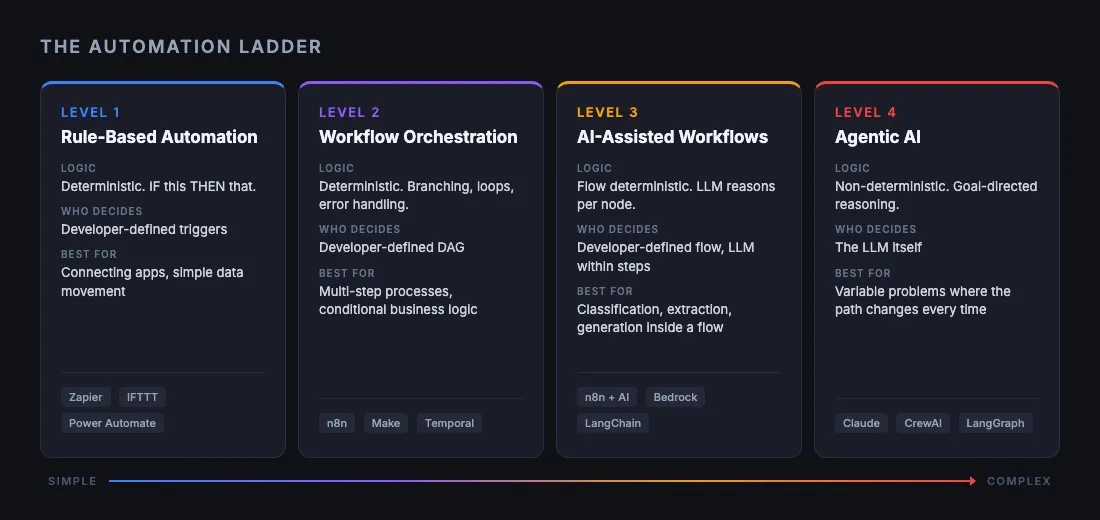
Level 1: Rule-Based Automation
IF this THEN that. A form submission triggers a CRM entry and an email. A payment webhook creates an invoice. A calendar event sends a Slack notification.
The industry calls these iPaaS tools. Integration Platform as a Service. Zapier, IFTTT, Microsoft Power Automate. You wire up deterministic triggers between applications. No logic, no branching, no reasoning. Input goes in, output comes out, the same way every time.
Most small businesses should start here. 80% of the automation problems a 10-person company faces are connection problems. Data exists in one place and needs to exist in another. A rule-based trigger solves that for $20 a month.
The mistake is skipping this level because it feels unsophisticated. Everything above it sits on this foundation.
Level 2: Workflow Orchestration
The moment your automation needs an IF statement, you have outgrown level one.
At this level, you design multi-step flows with conditional branching, loops, error handling, retries, and human-in-the-loop gates. The flow is still deterministic. You design the path. The system follows it without deviation.
n8n, Make, Temporal, Camunda. The industry calls these Digital Process Automation tools. Gartner groups them under BOAT: Business Orchestration and Automation Technologies. You use them when trigger-action tools cannot handle the complexity.
When an order comes in, check inventory. If available, route to fulfillment. If not, add to the backorder queue and notify the customer. If the customer is a VIP, escalate to the account manager. Each branch is defined. Each outcome is predictable.
Most small businesses should live at this level. n8n is open source and self-hostable. Make starts at $9 a month. The ROI is enormous because you are automating decision trees that currently live inside someone’s head. When that person goes on vacation, the decision tree goes with them. Your workflow does not.
Level 3: AI-Assisted Workflows
You keep the same orchestration, the same predefined flow. But individual nodes in that flow call a language model.
The developer who designed the flow still controls what happens next. The path is predefined. But specific steps use LLMs for tasks that rule-based logic cannot handle: classification, summarization, data extraction.
A support ticket arrives. An AI node classifies the priority and intent. Based on that classification, the deterministic flow routes it to the right team. Another AI node drafts a response. A human reviews and sends it.
The distinction matters: the LLM works within the flow. You defined the steps. The LLM executes one of them and passes the result forward.
Most people who say AI agent mean this level. Call it what it is: a workflow with AI-powered nodes. For most small businesses, this is where the ROI lives.
Anthropic and Andrew Ng draw the same line. In a workflow, the developer defines the code path and LLMs execute steps within it. In an agent, the LLM directs its own process and picks its own tools. Level three is a workflow. Level four is an agent. Most production systems in 2025 and 2026 that call themselves agents are level three.
Level 4: Agentic AI
Every headline about AI agents is about this level. Few production systems actually run here.
An agentic system is non-deterministic. The LLM decides which tools to call, in what order, and when to stop. It reasons toward a goal. It plans. It self-corrects when something fails. It can take a different path every time it runs.
You give it a goal: research this company, find the right contact, draft a personalized outreach email, and schedule it for the optimal send time. The agent decides how to accomplish that. It might query a database, search the web, check a CRM, compose the email, and decide to wait until Tuesday morning to send it. None of those steps were predefined. The agent planned them based on the goal and the data it found along the way.
We built an 8-agent prospecting system at SampleHQ. One agent researches companies. Another enriches contact data. Another scores leads against our ICP model. Another drafts outreach. Another handles follow-up scheduling. They coordinate, hand off work, and make decisions about what to do next without a predefined flow telling them the order.
It works. It also took months to build, requires monitoring, costs three to five times more in API calls than level three, and occasionally does things nobody expected. When an agent surprises you by finding a better approach, you are glad you built it. When it surprises you by emailing the wrong person at 2am, you are not.
Which Level Does Your Business Need?
The agentic AI market is growing at 43.8% CAGR. The RPA market at 24.2%. 82% of small businesses have invested in AI tools, with a median of five tools per business. The pressure to build agents is real and it comes from every direction: investors, Twitter, conference stages, competitors who claim to be using them.
But most production agentic systems in 2025 and 2026 are actually level three. Predefined flows with AI nodes. They get called agents for marketing reasons. They work because the flow constrains the AI to do useful work within a controlled path.
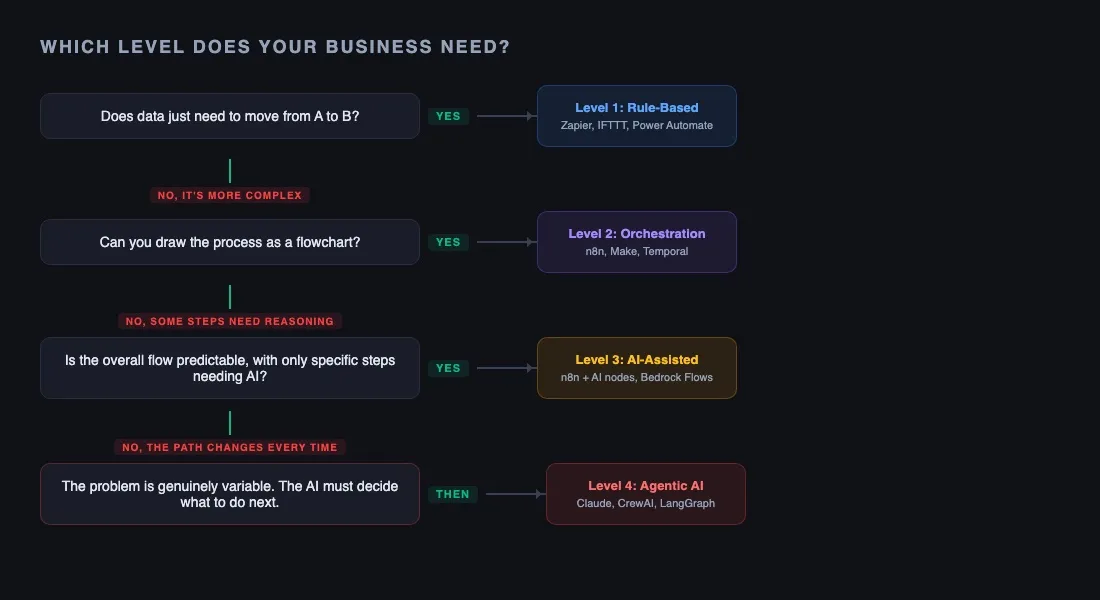
If you can draw the process as a flowchart, you need level two or three. Not level four. Same steps every time with different data? Level two. Some of those steps require reasoning or generation? Level three. The process changes every time because the right action depends on what the system discovers at runtime? Now you need an agent.
The Rule of Thumb
Start at level one. Connect your systems. Get data flowing between the tools you already use. Most businesses skip this and go straight to AI, which means they are building intelligent systems on top of disconnected data. That does not work.
Branching logic is the signal to move to level two. When the process has IF statements, exception paths, and decision points that a simple trigger cannot handle, you need orchestration.
The jump to level three happens when a step in your workflow requires reasoning you cannot express as a rule. Classifying unstructured text. Extracting data from formats that change every time. An AI node inside your existing workflow handles that without rebuilding the whole system.
Level four is for problems where you cannot define the flow in advance. Sales prospecting, complex research tasks, incident response across multiple systems. If the right action depends on what the system discovers at runtime, you need an agent. For everything else, you do not.
What This Looks Like in Practice
At SampleHQ we use all four levels. They are layers, not competing approaches.
Provisioning runs on level one. A subscription webhook fires, the site gets created. Deterministic, same steps every time. A Zapier-style trigger would handle it. We built it into the platform, but the principle is identical.
Order fulfillment is level two. When a sample request comes in, the system checks inventory, validates the shipping address, selects the carrier based on rules, generates labels through our background processing pipeline, and updates the CRM. Branching logic, error handling, retries on API failures. This is the same pattern you would build in n8n.
Lead scoring is where we brought in an LLM. Inbound contacts pass through an enrichment pipeline that calls external APIs, then an AI node classifies the company against our ICP criteria. The flow is predefined: enrich, score, route. But the scoring step needs judgment that rules cannot capture. Is this a packaging company that sends physical samples? That question requires understanding context, not matching keywords.
Our prospecting system is the only part that runs as true agents. Eight of them research, enrich, score, draft, and schedule without a predefined sequence. The research agent might find something that changes the outreach strategy. The enrichment agent might discover data that reclassifies the lead. The system adapts. That is why it requires agents, not workflows.
The Honest Cost
Rule-based automation runs $20 to $100 per month in platform fees. You can set it up in an afternoon.
Workflow orchestration is comparable if you self-host n8n, or $20 to $200 on hosted platforms. Budget a few days for setup and testing.
AI-assisted workflows add LLM API costs on top. Depending on volume, $50 to $500 per month for a small business. The real cost is time: designing prompts, testing outputs, handling the edge cases where the LLM produces unexpected results. Plan for weeks, not days.
Agentic systems cost the most across every dimension. API calls multiply because agents make multiple tool calls per task. You need monitoring infrastructure from day one. You will spend months building before anything runs in production. And you will keep maintaining it because agents encounter situations you did not anticipate, which is the whole point of using them.
The companies getting the most from automation matched the right level to each problem. A level two workflow running reliably every day will outperform a level four agent that you have to babysit.
Most of the value is on the lower rungs. Connect your tools, automate the decision trees, add AI where a step actually requires reasoning. Build an agent when the problem demands one and not a minute before.
If you are building operational workflows for packaging and need sample tracking, CRM integration, and fulfillment automation in one platform, that is what SampleHQ is for.