 Bojan
BojanWhy Sample Operations Break Between Sales and Fulfillment
Sales requests samples. Fulfillment ships them. Nobody closes the loop. The handoff between these two teams is where sample data disappears and follow-up dies.
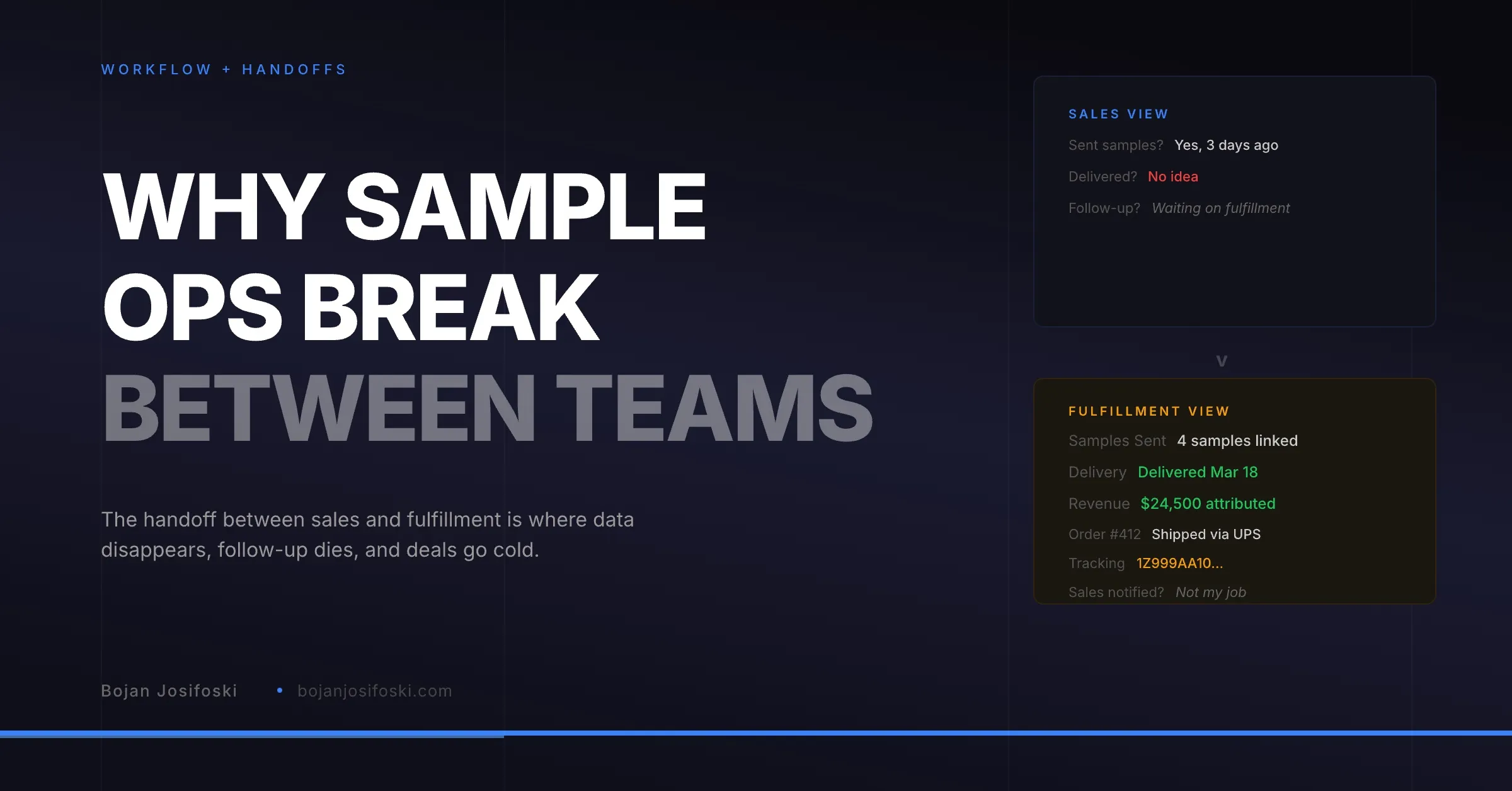
In almost every sample-driven business I have talked to, the same pattern plays out. Sales decides a prospect needs samples. They communicate this somehow, through email, a Slack message, a form, or a verbal request. Fulfillment picks it up, packages the samples, ships them, and moves on to the next order.
That is where the process stops. Not because anyone is doing their job wrong, but because the systems connecting these two teams were never designed to close the loop. Sales does not know when the sample shipped. Fulfillment does not know why the sample matters to the deal. And the data that would connect the two lives in nobody’s system.
The Information Asymmetry Problem
Sales teams operate in CRM context. They know the deal stage, the contact history, the competitive situation, and the timeline for a decision. When they request samples, they have a specific reason: the prospect wants to test a substrate, compare print quality, or show the packaging to their own customers.
Fulfillment teams operate in operational context. They know what is in stock, what needs to be cut or printed, which carrier to use, and how to get the shipment out efficiently. They do not know, and usually do not need to know, the sales context behind the request.
This asymmetry is natural. Different teams have different jobs. The problem is that the handoff between them destroys information in both directions. Sales loses visibility into operational status. Fulfillment loses context about urgency and importance. And nobody owns the gap between “shipped” and “delivered.”
Where the Data Disappears
There are specific points in the sample workflow where data reliably vanishes.
At request intake. If the request comes through email or Slack, there is no structured record. The recipient’s address might be in the email body, or it might need to be looked up. The specific samples requested might be described vaguely. The deal context is usually missing entirely. Every downstream step inherits this ambiguity.
At status transitions. When fulfillment marks an order as “processing” or “shipped,” that status change rarely propagates back to sales. If the tracking lives in a spreadsheet, the sales rep would need to know where to look and when to check. Most do not.
At delivery. This is the biggest gap. A carrier delivers the package. Someone at the prospect’s office signs for it. But the sales rep in your CRM does not know this happened. The follow-up call that should happen within 48 hours of delivery happens a week later, or never.
At attribution. When the deal eventually closes, nobody connects it back to the samples that were sent. The attribution gap means the sample program gets no credit for revenue it helped generate.
Why Shared Spreadsheets Do Not Fix This
The instinctive response to this problem is a shared spreadsheet or a shared Slack channel. Put all the order information in one place and everyone can see it.
This fails for the same reasons all spreadsheet-based workflows fail. Multiple editors create version conflicts. There is no notification system. There are no permissions, so fulfillment sees deal amounts they should not, or sales accidentally edits tracking numbers. And the data format is too flat to capture the relationships between orders, recipients, shipments, and deals.
The problem is not access. The problem is that sales and fulfillment need different views of the same data, with different permissions, different notification triggers, and different actions available. A spreadsheet gives everyone the same view. A system gives each team what they need.
What the Handoff Actually Needs
Having built a system to solve this, I can describe what the handoff between sales and fulfillment actually requires.
Structured intake. Sample requests need to capture the recipient, the specific samples, the shipping address, and optionally the deal context. This does not mean a ten-field form. It means enough structure that fulfillment can process the order without a follow-up email asking for the zip code.
Role-based status visibility. When fulfillment updates the order status, sales should see the change without checking a separate system. When a tracking number is added, the rep should be notified. When delivery is confirmed, the rep should get a prompt to follow up. These are not complex notifications. They are basic state machine transitions that trigger the right message to the right person.
Separate interfaces for separate jobs. Fulfillment needs a shipment queue: orders sorted by priority, with batch actions for printing packing slips and purchasing shipping labels. Sales needs an order list filtered to their accounts, with delivery status and deal context visible. These are different tools that read from the same data.
A shared audit trail. When something goes wrong, both teams need to see what happened. Who created the order? When was it shipped? When was tracking added? Was delivery confirmed? This trail resolves disputes, identifies bottlenecks, and builds accountability without blame.
The Follow-Up Problem
The most expensive failure in the sales-fulfillment handoff is not a delayed shipment. It is a missed follow-up.
Samples are sent to advance deals. If the rep does not follow up after delivery, the sample served no purpose. The prospect puts it on a shelf, gets busy with other vendors, and the deal goes cold. When the rep finally calls two weeks later, the window has closed.
This is not a motivation problem. Reps want to follow up. The problem is that they do not know when delivery happened. If delivery status lives in a carrier portal that nobody checks, the follow-up window passes without anyone noticing.
A system that notifies the rep when delivery is confirmed, and surfaces that notification in the CRM where they are already working, solves this without requiring any change in behavior. The rep does what they always intended to do. They just get the signal at the right time.
Coordination Without Meetings
One pattern I see in teams that rely on manual handoffs is an increase in coordination meetings. Weekly syncs between sales and fulfillment to go through the order list, check statuses, and identify problems. These meetings exist because the systems do not provide the visibility that both teams need.
When the system handles status propagation, delivery notifications, and shared visibility, those meetings become unnecessary. Not because coordination is unimportant, but because the coordination happens automatically through the workflow. The meeting that used to review “did this ship?” and “when will that be ready?” no longer has an agenda.
This is the real value of fixing the handoff. Not just fewer errors, but less friction. Less time spent asking for updates. Less interruption of fulfillment’s work by sales asking for status. Less anxiety from reps who do not know whether their samples arrived.
If the handoff between your sales and fulfillment teams feels broken, SampleHQ was designed to solve exactly this. Shared visibility, role-based workflows, delivery notifications, and CRM integration in one system.