 Bojan
BojanWhat AI Actually Looks Like in Sample Operations (Not What You’d Expect)
Most AI content about manufacturing is vaporware. Here is what AI concretely does inside a sample workflow today: natural language search, follow-up generation, and anomaly detection grounded in real operational data.
Every software company is rushing to add “AI-powered” to their marketing. Most of what they ship is a chatbot wrapper that answers questions about help docs. That is not AI in operations. That is a search bar with extra steps.
I have spent the past year building AI features into a sample management platform. Not because AI is trendy, but because there are specific operational problems where language models are genuinely useful. The gap between what AI marketing promises and what AI actually delivers in operations is worth examining, because teams evaluating tools deserve to know the difference.
The Problem AI Solves in Sample Operations
Sample operations generate a lot of structured data: orders, shipments, delivery dates, recipients, deal associations, attribution values. The data is there. The problem is that querying it requires either navigating multiple screens and filters, or asking someone who knows the system well enough to pull the right report.
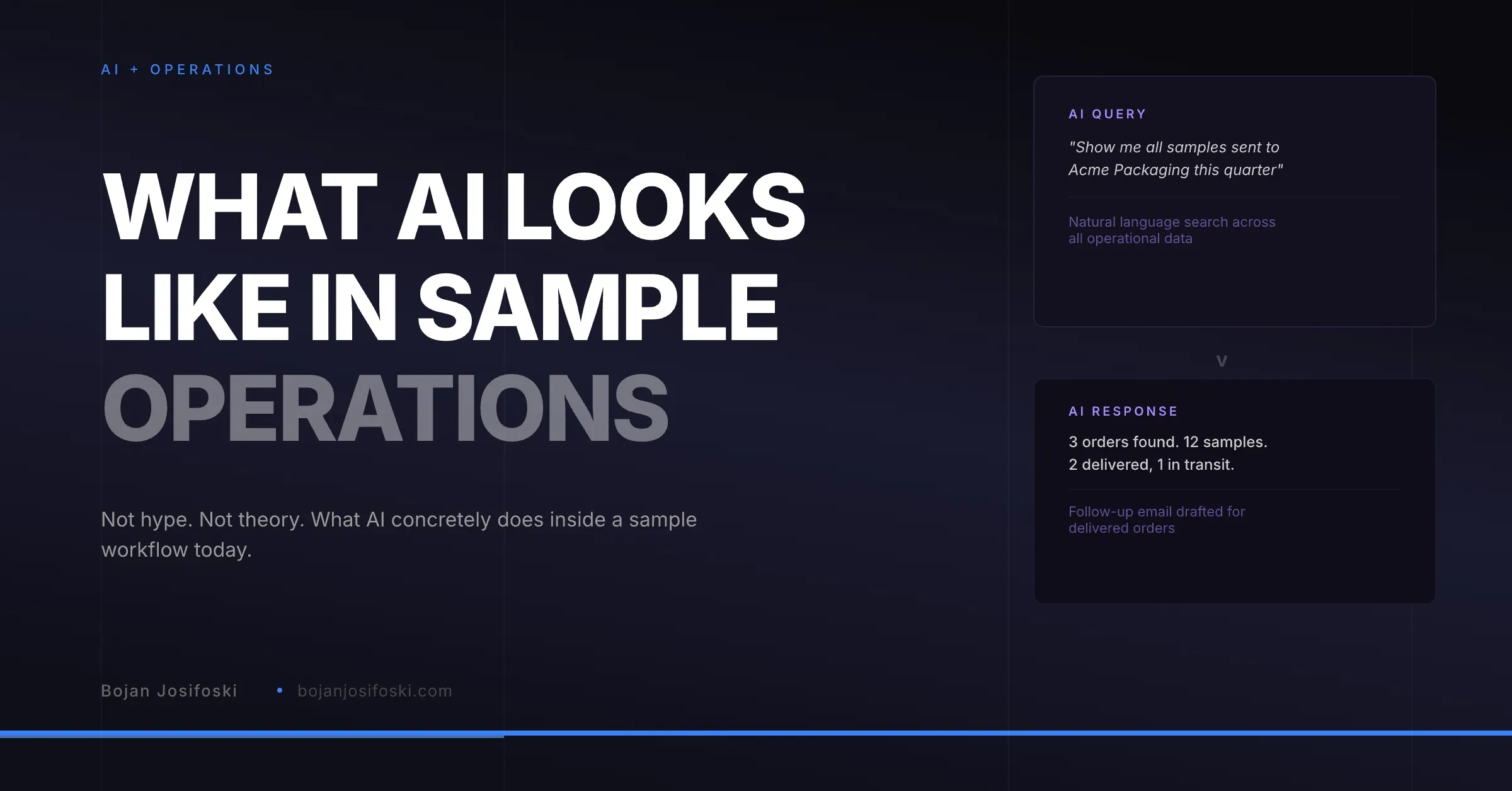
When a sales leader asks “what samples did we send to Acme Packaging this quarter?” the answer exists in the system. But getting it requires filtering orders by account, selecting the right date range, and cross-referencing with CRM data. That is a two-minute task for someone who knows the interface and a five-minute task for someone who does not.
AI makes that query a sentence. You type the question in natural language, and the system translates it into the right database query, runs it, and returns the answer in context. That is not magic. It is a well-scoped application of language models to structured data retrieval.
Natural Language Search Across Operations Data
The most useful AI feature I have built is natural language search that understands the operational data model. Not a generic chatbot, but an agent with access to purpose-built query tools that know how to search orders, samples, customers, deals, and attribution data.
The key insight is that the AI needs structured query builders, not raw database access. When someone asks “which samples were in deals that closed last month?” the system does not generate SQL. It calls an attribution query builder that knows the relationships between samples, orders, deals, and close dates. The query builder returns structured results that the AI then formats into a readable response.
This matters because it means the AI cannot hallucinate data. It can only return what the query builders find in the actual database. If no samples match the query, the response says so. It does not invent plausible-sounding numbers.
Follow-Up Email Generation
When a sample order is delivered, the natural next step is a follow-up email from the sales rep. But writing that email requires context: what was sent, when it was delivered, what deal it supports, what the customer’s history looks like.
AI can draft that email because it has access to all of that context through the same query tools. The rep gets a draft that references the specific samples, the delivery date, and the deal context. They edit it, personalize it, and send it. The AI handles the assembly of context. The human handles the judgment about tone and timing.
This is not revolutionary technology. It is a practical application of language models to a specific workflow step where context assembly is the bottleneck, not creativity.
Anomaly Detection for Sales Patterns
Another concrete use case: monitoring operational data for patterns that warrant attention. If sample request volume drops significantly compared to the trailing average, that might indicate a pipeline problem. If a specific product’s sample requests spike, that might indicate market interest worth investigating. If a rep’s follow-up rate drops below their historical average, that is a coaching opportunity.
These are not complex machine learning models. They are threshold-based checks that run on a schedule, with AI providing the natural language summary of what changed and why it might matter. The value is not in the detection algorithm. It is in the translation from raw data to actionable insight in plain language.
What AI Does Not Do Well in Operations
Honesty matters here. There are things AI is not good at in this context, and pretending otherwise would be irresponsible.
AI cannot reliably make decisions about operational processes. It can surface data and draft content, but it should not autonomously change order statuses, send emails without human review, or modify attribution assignments. The consequences of errors in operational data are too high for unsupervised AI action.
AI also struggles with context that is not in the system. If a deal is stalled because of a personal relationship issue between the rep and the buyer, no amount of operational data will surface that. AI works with what it can see. Human judgment covers what it cannot.
And AI is not a substitute for good systems design. If your sample data lives in spreadsheets and email, AI has nothing useful to query. The AI features I have described only work because there is a structured operational system underneath them. The system came first. The AI came second.
Multi-Provider Architecture
One technical decision worth mentioning: we built the AI layer to support multiple providers. The system works with OpenAI, Anthropic’s Claude, and other providers through a factory pattern. This is not about vendor hedging. It is about giving teams the option to use the model that best fits their security and compliance requirements.
Some organizations require that data stays within specific geographic boundaries. Others have existing enterprise agreements with specific AI providers. A single-vendor AI integration forces everyone onto the same model regardless of their constraints. A multi-provider architecture lets the operational system work with whatever model the organization has already approved.
The Honest Value of AI in Sample Ops
AI in sample operations is not transformative in the way that marketing copy suggests. It does not replace people. It does not automate entire workflows. It does not generate strategic insights from thin air.
What it does is reduce friction in specific steps: querying data, drafting context-rich communications, and surfacing patterns that would take manual effort to find. These are real time savings that compound across a team. A rep who gets a contextual follow-up draft thirty seconds after delivery confirmation is more likely to follow up than one who has to assemble the context themselves.
That is the honest pitch. Not AI that replaces your team. AI that makes the system your team already uses faster and more useful.
SampleHQ includes AI-powered search, follow-up drafting, and operational monitoring. It works because the operational data model underneath it was designed to be queried, not because the AI is doing anything magical.